
Beyond Mental
A Proposal for a Model for Understanding “Mental Health”


In 1952, the American Psychiatric Association published the first Diagnostic and Statistical Manual of Mental Disorders (DSM), and that became the start of a transformation in how Western societies would understand psychological suffering for the next seventy years. The DSM provided a common language for psychiatrists, a set of categories that could be applied consistently across clinics and hospitals, and a framework that made mental health treatment eligible for insurance reimbursement. The manual defined conditions like Major Depressive Disorder, Generalised Anxiety Disorder, and Schizophrenia as distinct illnesses with identifiable symptoms, and each edition that followed — DSM-II in 1968, DSM-III in 1980, DSM-IV in 1994, and DSM-5 in 2013 — expanded the scope of what could be classified as a mental disorder until the framework included grief as a depressive episode and childhood shyness as a social phobia. The medicalisation of psychological suffering gave psychiatry the legitimacy it had long sought within the broader medical profession, and it gave patients a vocabulary for their distress, but it also made a fundamental claim that has never been properly examined: that the source of psychological distress lies within the person who experiences it, and that correcting the individual through therapy, medication, or both will resolve the distress.
I think this approach isenza sibone lufifi (makes us to only see in part).
Psychological suffering is not the disease per se, but a symptom that there is a larger problem, akin to a dying plant. In the vast majority of instances, a dying plant is a product of its environment rather than an inherent defect within the plant itself. In fact, the DSM once acknowledged this principle in one limited case by containing a “grief exemption” that prevented the diagnosis of Major Depressive Disorder in people who had recently lost a loved one, and this exemption was based on the recognition that grief is a normal response to loss rather than a disorder. The exemption remained in place through several editions of the DSM until the American Psychiatric Association removed it in the DSM-5, allowing clinicians to diagnose depression in the bereaved, and the logic that justified that removal is the same logic that I want us to now extend to almost every category of psychological distress. A person who is grieving looks like a person who is depressed, the reasoning went, and treating grief as depression allows more people to access treatment, but this reasoning collapses the distinction between a proportionate response to loss and a disorder of the brain, and it signals that any suffering, no matter how contextual, can be redefined as a disease.
In this essay, I want would like to opine, or perhaps propose, that almost all psychological disorders deserve the grief exemption, because depression, anxiety, burnout, and despair are normal responses to abnormal environments, and the person experiencing them is not inherently defective or weak but accurately reporting on the absence of the conditions required for human flourishing.
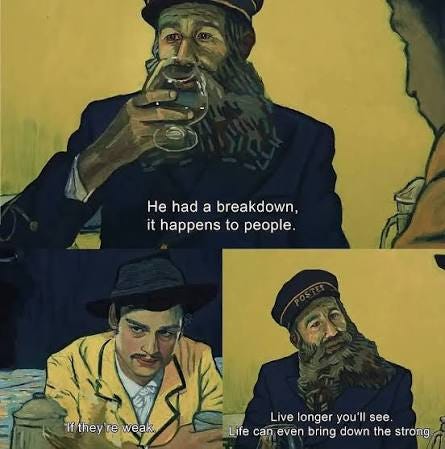
Part 1. What Is Psychological Health?
In my opinion, psychological health is the capacity to engage with life stressors (trauma, obsessions, nuisances, and noise) without crumbling, and this capacity is better understood as resilience rather than happiness. Therefore, this means that a person can be psychologically healthy while profoundly unhappy, while grieving, or while living under occupation, as many people living in poverty, chronic illness, and war-torn territories have demonstrated. Inversely, a person can be psychologically unhealthy whilst they deeply comfortable in material things, such as a wealthy person who cannot sleep without medication. When the conditions required for psychological health are increasingly absent, psychological health deteriorates, and this deterioration is not a disease but a normal, and sane response to an abnormal environment. A human being placed in solitary confinement will deteriorate psychologically, and this deterioration occurs not because the person has a confinement disorder but because human beings require social connection to remain healthy. Similarly, a human being subjected to chronic unpredictable stress will develop hypervigilance and anxiety, and these states emerge not because the person has an anxiety disorder but because the nervous system has been trained to expect threat through repeated exposure to unpredictable danger. In the same way, a human being deprived of meaning, purpose, and a coherent worldview will experience existential despair, and this despair arises not because the person has a depression disorder but because the human mind requires a narrative framework to function and make sense of experience.
One of my all-time favourite writers Dr. Viktor E. Frankl, holocaust survivor and psychiatrist, documented this philosophy in Man’s Search for Meaning, which he published in 1946 after surviving four concentration camps including Auschwitz and Dachau, and his observations have become one of the most influential accounts of psychological resilience ever written, and the foundation of logotherapy. Frankl observed that prisoners who could identify a purpose were significantly more likely to survive than those who could not, and this observation was consistent across all accounts regardless of physical strength, intelligence, or social status within the camp. The prisoners who survived were not the happiest or the healthiest; they were the ones who had a support structure that buffered them against the complete degradation of their environment. Frankl himself was starving, exhausted, and beaten, and he was not happy, but he was psychologically healthy in the sense defined here because he could engage with the stressor without crumbling by finding meaning in the attitudinal value of bearing hardship with dignity, the creative value of reconstructing his manuscript, and the experiential value of love for his wife. Of course, the concentration camp is an extreme example, but it clarifies this philosophy by showing that when the support structure is stripped away, the human being deteriorates; not because of an inherent weakness in the human being but because of a defect in the environment, and the appropriate response to this deterioration is not to treat it as a disease but to restore the supports that have been removed.
Part 2. The Basic Five Core Supports A Human Needs (In My Opinion)
If psychological health is a function of environmental conditions, then those conditions must be identified, and I think the five core supports that are necessary for psychological health to flourish are (agape) love, meaningful work, physical needs met, community, and purpose. These supports are not sufficient individualy, but the presence of any one can act as a buffer against deterioration, while the absence of all five is a near-certain predictor of psychological breakdown.
Love is the foundational support, and it means at least one person who knows you fully and accepts you unconditionally, not performatively, not transactionally, and not because you are useful to them. The science of attachment theory, developed by John Bowlby and Mary Ainsworth in the mid-twentieth century, demonstrates that the presence or absence of love in early life predicts psychological outcomes decades later. Infants who are held and responded to develop secure attachment, while infants who are neglected develop hypervigilance, dissociation, and a lifelong difficulty in trusting others, and these patterns persist into adulthood unless significant intervention occurs. Love does not have to come from a parent, but it must come from somewhere, because without it the human being is relationally starved and the nervous system remains dysregulated.
Meaningful work is activity that engages your capacities and produces something of value to others, whether paid or unpaid, and it can take the form of raising children, building furniture, coding software, farming land, writing poetry, or caring for the elderly. Meaningful work does not mean a job, and this distinction is crucial because most people hold jobs that provide income but no satisfaction.Meaningful work answers the question “why get up in the morning?” by providing structure, purpose, and a sense of competence, and these elements are essential for psychological health because they give the day a reason to be endured. The modern economy has systematically eroded meaningful work because most people work to survive, selling their time to perform tasks that hold no intrinsic meaning and becoming cogs in a machine that does not care about them as individuals.
Physical needs met is the most obvious support (as most of us have engaged with Maslow’s work), and yet he most frequently ignored. Physical needs encompasses safe housing, nutritious food, clean water, adequate sleep, physical safety, and access to healthcare. None of these needs are negotiable because a human being who is hungry, exhausted, or unsafe cannot be psychologically healthy. The body’s stress response is an autonomic reaction to threat and deprivation, and when physical needs are chronically unmet, the brain’s architecture changes as cortisol levels remain elevated, the immune system is suppressed, the hippocampus shrinks, and the prefrontal cortex becomes impaired.
Community is the recognition that human beings are social animals who evolved in tribes, and our nervous systems are calibrated to expect the presence of others so that we can look to them for safety, validation, and shared meaning. Community is the group of people who know your name, who show up when you are in crisis, who share your physical space and your daily rhythms, and the modern world has systematically destroyed community through suburbanisation, car dependency, digital isolation, the decline of religious institutions, the privatisation of public space, and the collapse of extended family structures. Community is not Facebook friends, followers, or parasocial relationships with influencers, because these relationships lack the mutual vulnerability and physical presence that characterise genuine community. The decline of commnuity has atomised human beings into isolated individuals who live among strangers and die among strangers, and the psychological toll of this isolation is measurable in rising rates of depression, anxiety, and suicide.
Lastly, purpose or belief in a higher power is equally important, because human beings require a framework that makes sense of suffering, randomness, and mortality. This support can take the form of religion, spirituality, philosophy, a commitment to social justice, a belief in the progress of humanity (meliorism), or a sense of being part of something larger than oneself, and when it is absent, meaningless suffering is far harder to bear than suffering that serves a purpose. Without such a framework, the existential weight of existence becomes unbearable, and the individual is left to face the universe alone with their suffering still present but now meaningless.
In essence, to endure life stressors without crumbling, you need to atleast have your needs met, have one person who loves you, be engaged in meaningful work, have a community to go through suffering with you, and find meaning in that suffering.
Part 3. Let’s Get Into Detail of What This Means
The five core supports I have outlined are broad categories that encompass specific conditions which can be observed, measured, and eroded. And if we examined each condition in detail, we can reveal how modern society has systematically dismantled the infrastructure and support needed for psychological health, and the evidence for this erosion is found in our modern society. If we were to take the five conditions for pyschological health I have laid out, and expanded them, we arrive at approximately upto twenty-ish conditions a human being needs for psychological health, and the consequence of their erosure. Here they are, in no perticular order:
Safe, stable housing means a home that is affordable, secure from eviction, free from hazards, and located in a neighbourhood that provides safety rather than threat. In Zimbabwe, the cost of rentals has outpaced wages for decades, forcing young people to live in overcrowded conditions while moving from one informal rental to another without ever feeling secure. Landlords demand rent, deposit, and agent fee upfront, and evictions are common. So, the home meant to be the primary site of safety has become a source of chronic insecurity. Globally, housing has been financialised so that it is no longer a human right but an asset class, and the people who work in cities cannot afford to live in them. The United Nations reported in 2022 that over 1.6 billion people live in inadequate housing worldwide, and the number has increased steadily since the 2008 financial crisis, with the result that chronic stress, constant hypervigilance, and a baseline of insecurity make psychological health nearly impossible for a significant portion of the global population.
Nutritious food and clean water means reliable access to food and uncontaminated drinking water, and this access is essential because the brain cannot relax when it does not know where the next meal is coming from and the brain cannot develop properly when it is malnourished.
Physical safety from violence means freedom from domestic abuse, community crime, state violence, and war, and this freedom is essential because the nervous system cannot rest when violence is a constant threat.
Adequate sleep and rest means seven to nine hours of uninterrupted sleep per night, and this amount is essential because the brain clears toxins during sleep and without it cognitive function deteriorates, emotional regulation is impaired, and the risk of depression, anxiety, and suicide increases. In most ghettos/slums/kasis, the vast majority cannot afford soundproof housing, thus sleeping through noise, filth, and the constant threat of violence. This sleep deprivation is linked to increased rates of depression, anxiety, and suicide, because this erosion is not a disease but the body’s inability to function without rest.
Access to physical healthcare means the ability to see a doctor, receive treatment, and afford medication when needed, and this access is essential because untreated physical pain is a relentless psychological stressor and untreated chronic illness erodes the capacity for hope. In Zimbabwe, public hospitals are chronically underfunded, understaffed, and lacking basic supplies, and a simple infection can become a major health crisis while chronic conditions like diabetes, and hypertension, require consistent treatment that many cannot afford.
A clean environment means air that is breathable, water that is drinkable, and noise levels that do not assault the nervous system, and this cleanliness is essential because the human body evolved to respond to environmental cues, with a clean, quiet environment signalling safety while a polluted, noisy environment signals threat.
Unconditional love from at least one person means a relationship in which you are accepted as you are, without conditions, performance requirements, or the threat of withdrawal, and this love is essential because the presence of a secure attachment figure is the single strongest predictor of psychological resilience. Without unconditional love, the nervous system remains dysregulated and the individual is constantly searching for validation, never finding it and never trusting it when it appears. In orphanages, in abusive homes, and in households where parents are emotionally absent, children learn that love is conditional — earned, lost, never guaranteed — and this learning is not a mental health disorder but accurate learning in response to accurate feedback. The evidence for the erosion of unconditional love is found in the global rise of single-parent households, and studies showing that insecure attachment in childhood predicts depression, anxiety, and relationship difficulties in adulthood. There is a 1975 Minnesota Longitudinal Study of Risk and Adaptation that followed individuals from birth to age 40 and found that early attachment security predicted psychological health decades later, while insecurity predicted a range of mental health diagnoses and relationship failures.
Reciprocal friendships means relationships of mutual care, mutual trust, and mutual vulnerability, where you know that someone will show up for you and you for them, and these friendships are essential because human beings require peer relationships to maintain psychological health. Friendship is not Facebook friends, WhatsApp groups, or acquaintances who like your posts, because these relationships lack the depth and reliability of genuine friendship. In the modern world, friendship has been weakened by demanding adulthood, geography, overwork, and digital substitution, and a person can have hundreds of friends online and no one to call in a crisis. Again, the loneliness epidemic is not an inherent failure of the individual but the structural collapse of the conditions that make friendship possible.
Being genuinely seen and understood means the experience of being known in your specificity, your history, and your interior world, of being listened to without judgment and validated without condition, and this experience is essential because it provides the foundation for self-knowledge and self-acceptance. In therapy, this experience is called the therapeutic alliance and is one of the strongest predictors of positive outcomes, but it should not require therapy because it should be available in everyday life through relationships, family, and community. We cannot therapy our way out of lack of community.
Belonging to a stable group/tribe means being recognised as one of us through shared identity (family, ideological, ethnic etc), shared ritual, shared history, and the knowledge that you are part of something that predates you and will outlast you, and this belonging is essential because human beings need to know that they are not alone in the universe. The decline of religious institutions, clubs, community organisations, and extended family networks has left many people without any group to belong to, and they become isolated individuals floating in a sea of others who are equally isolated. The result is a population that lacks the sense of belonging that previous generations took for granted, and we are witnessing the psychological consequences in real-time.
A sense of being needed or responsibility means knowing that someone or something relies on you — a child, a pet, an elderly relative, a team, a community project — and this sense is essential because it gives the day a reason to be endured. In modern economies, most people are not needed, because they are replaceable, with the company not needing them but their labour and the community not needing them because there is no community. The individual becomes disposable, and the psychological toll of being disposable is profound. We now famously joke that if you were to die today, the company you work for would replace you before your body got cold.
Financial stability means predictability, not wealth, and it means knowing that bills can be paid, emergencies can be absorbed, and basic needs are not in constant jeopardy. I have written a white paper arguing that income predictibility is a better indicator of vulnerability over income amount. Financial stability is essential because the body cannot relax when the future is uncertain, and the constant uncertainty of financial precarity is a source of chronic stress that affects every aspect of life. In Zimbabwe, hyperinflation has made financial stability impossible for most people because the value of savings evaporates overnight and wages are paid in currency that loses value by the hour. Additionally, we live in a post-career world where precarious work has become the norm, with temporary contracts, zero-hour contracts, and gig work all ensuring that the worker never knows what their income will be next month.
Access to education and skill-building means the opportunity to learn how the world works, how to navigate it, and how to acquire the skills that make life meaningful and productive, and this access is essential because education is the primary mechanism for developing a sense of agency. In much of Africa, education is underfunded, overcrowded, and more importantly, outdated; additionally, education is increasingly vocational, teaching you how to be a worker rather than how to be a human, and the result is a population that is functionally illiterate in the skills of living: critical thinking, emotional regulation, relational depth, and civic engagement. Our lack of basic digital skills, and the gap between the educated and the uneducated, is creating a class of people who are locked out of agency and opportunity.
A fair justice system means protection from arbitrary arrest, corruption, and bureaucratic cruelty, and this protection is essential because the state should be a source of protection rather than threat. Normal people in stable democracies rarely experience arbitrary arrest, corruption, or bureaucratic cruelty, but in Zimbabwe the police are a predatory institution, and bribery is the price of basic services. When the state is a source of threat rather than protection, the individual is forced into hypervigilance, trust becomes impossible, safety becomes elusive, and the nervous system is permanently on guard. We have created a low-trust society.
Geographic opportunity means living in a place that offers functional infrastructure, a working economy, and social mobility, and this opportunity is essential because a person born in a thriving city has options while a person born in a rural area with no jobs, no infrastructure, and no future does not. Migration is one of the oldest human strategies for survival, but migration is increasingly difficult as borders are closed, wealthy countries are screaming abahambe (migrants should leave), visas are increasingly expensive, and now the poor are trapped where they are. In my book, “Learning to See: 25 Essays on Life and Society”, in the chapter titled, “Everything affects everything”, I make the argument that a person’s circumstances are not a reflection of their worth but a reflection of the geography they were born into, and the psychological toll of being trapped in a place with no opportunity is profound.
A coherent worldview or narrative means a framework that makes sense of suffering, randomness, and morality, and this framework is essential because the human mind requires it to function. Without a coherent worldview, the world is chaos and the individual is adrift, and this condition can be secular, such as a philosophical system such as stoicism, a political ideology such as democracy, or a commitment to rationality, or it can be religious, such as a belief in God, in fate, or in karma, or it can be spiritual, such as a sense of connection to nature, to humanity, or to the universe. The framework must be coherent for cognitve sonnance, answering why there is suffering, what your role is, and what the point is, because without this every difficulty is a reason to give up and every setback is evidence of meaninglessness.
A sense of agency and control or being agentic means the belief that your actions can influence your life trajectory, not omnipotence but the felt sense that you are not purely a victim of circumstance, and this sense is essential because agency is learned through experience. When you act and the world responds, you learn that you matter, but when you act and the world does not respond, you learn helplessness. In modern societies, agency is systematically undermined as the economy is controlled by forces beyond the individual, the political system is designing itself to be immune to the opinions and votes of the public, and the environment is degraded, so the individual is one tiny actor in a global system that does not care. The learned helplessness is not a cognitive distortion but accurate perception of an unresponsive world, and studies consistently show that perceived powerlessness correlates with depression and anxiety at rates significantly higher than perceived control.
Lastly, meaningful contribution or legacy means the knowledge that your existence improves something beyond yourself, through raising children, creating art, building something, or advocating for change, and this knowledge is essential because human beings need to feel that their existence has mattered. In an atomised society, contribution is reduced to individual productivity, and you are useful insofar as you produce economic value, but human beings need to feel that their existence has mattered beyond the economic value they produce. In fact, we judge ourselves and others by our bank account balances, monthly photo dumps, and instagram profiles.The percentage of people who feel their life has meaning has declined across the globe, not only in Zimbabwe.
Part 4. So, Say You Do Not Have Any of These Things, What Are Survival Does One Have?
When these conditions are absent, human beings have a limited set of options, and these are not choices but adaptations — what the organism does to survive when the environment is toxic. When people are in hellish conditions, without any psychological safetynet (the afore mentioned conditions), in order to survive, they either resort to being psychopathic (in the perjorative, not medical sense), or delusional in order to find meaning, or find the needed support, or luck, and suicide. Let’s explore these, shall we?
Psychopathy or moral callousness is the emerges because if the world does not care about you, you stop caring about the world, and if loving is a liability, you stop loving, and if empathy makes you vulnerable, you suppress empathy. Moral callousness is a person who has learned that trust is punished and exploitation is rewarded will become exploitative, lying, cheating, stealing, and manipulating because that is what works. The rise of Yahoo boys in Nigeria, the proliferation of crypto scams in Kenya, Mbingarism in Zimbabwe, and the normalisation of corruption in South Africa are not signs of moral decay but signs of structural decay, because when the formal economy offers no path to survival, the informal economy of crime becomes a rational choice.
Delusion or obliviousness emerges because if reality is unbearable, you stop seeing it, and this dissociation, denial, and defensive structure make it possible to function in a dysfunctional world. Social media addiction is a form of oblivion e.g thinking you are an “influencer” or an “it girl”, and parasocial relationships with other influencers in place of community, excessive AI chatbot dependancy for emotional support, and over-religiosity (having your “prophet” or “papa”), are ways of being distracted from the absence of real relationships. The person who spends eight hours a day on TikTok is not mentally ill but adapting to a world that offers no alternatives, surviving by not noticing how bad it is.
Acquisition of supports one or more of the conditions I outlined above is the rational and pyschologically healthy strategy of using whatever conditions you have to acquire stronger conditions. If you have a weak support, such as living in a country with relative stability, you use that stability to find work, use work to afford housing, use housing to build community, use community to find love, and use love to develop purpose. This process is not linear but iterative, and it is the strategy of the person who has something to leverage and the cognitive capacity to do so. Frankl’s logotherapy is essentially this strategy: find the meaning in your suffering and use it to survive until the conditions improve.
Luck is another way to escape hellscape, and this is the exogenous factor of a stranger offering help, a scholarship being awarded, a job being offered, or a person falling in love. Read my essay titled “It’s All Luck”. Luck is not a strategy but a randomness, yet it is a real factor in survival, and the person who is rescued is not more deserving than the person who is not but simply luckier. The moral implication is that if luck is a factor in survival, then society has an obligation to manufacture luck by creating conditions where randomness is less decisive and ensuring that everyone has access to luck, that is, the supports they need regardless of what they were born into.
Lastly, when someone is hell can’t get lucky, acquire support, or delusional enough to ignore suffering, and they don’t have the stomach to steal or commit fraud, they are left with only one option, that is, rational suicide. I would like to propose that suicide is not a “mental health crisis” but a rational decision, the recognition that the cost of living has exceeded the benefit, and the quality of life has deteriorated beyond worth enduring. I posit to you that quality of life is way more important than life itself, which is why we are a species that engages in abortion - because we know that the child will have a worse life than they deserve. During slavery, in 1803, the Igbo slaves who jumped overboard at Igbo Landing because they would rather kill themselves than live in slavery in 1803; similarly, the Jewish defenders at Masada chose death over Roman captivity in 73 CE. These are not considered suicides in the medical sense but are seen as acts of resistance, of dignity, of agency - and what is true for the slave and the defender is true for the individual: a person with a chronic, painful condition that cannot be relieved, a person in a situation of absolute, unalterable deprivation, a person who has exhausted every rational option and found no path forward — for such a person, suicide is rational. Mark Fisher took his own life in 2017, Sigmund Freud, the father of psychology chose euthanasia in 1939, David Foster Wallace killed himself in 2008, and Avicii died by suicide in 2018, and these were not “irrational” acts but decisions made by people I consider very intelligent and reflective, who found the weight of existence unbearable and the prospect of relief impossible. Of course, the edge cases exist, such as the momentary impulse, the response to a breakup, or the decision made in the heat of a crisis, but the existence of edge cases does not invalidate the rationality of suicide as a general category because each case must be evaluated on its own terms. The medical model that brought us the DSM pathologises suicide, treating it as a disease, and assuming that if the disease were treated the suicide would be prevented, but this assumption avoids the structural question of why so many people are choosing to die. The answer is structural: approximately twenty conditions have been eroded, the survival options are limited, and suicide is the rational response of an organism that sees no path forward.
Part 5. Wait..What About Clinical Interventions (Medicine and Therapy)?
I think medication and therapy is invaluable - they are one of the miracles of modern medicine and positives of the modern medicalised “mental health”. However, clinical interventions are not cures but bridges, and they help people climb from zero to one. In their current state, they are expensive, inaccessible, and gatekept, and they are not the solution but the scaffolding that makes the solution possible. Living problems must be decoupled from mental health problems because a person who is hungry does not have a mental health problem but a hunger problem, a person who is homeless does not have a mental health problem but a housing problem, and a person who is lonely does not have a mental health problem but a community problem. The conflation of these problems serves no one because it pathologises the individual, and the first step in any clinical intervention must be to identify which problem is being addressed. Because the clinical interventions are important to help a person stabilise enough to get access to other points of support, I think they must be subsidised so that anyone who needs them can access them, and this subsidy must extend to things like lithium, antidepressants, antipsychotics, and other essential medications at the lowest possible cost while therapy is available when needed. However, pipelines to escape hellscape must be prioritised, such as, job and education scholarships. The greatest antidepressent is stability, and a hopeful future.
In Summary...
Here is the thing: We need to understand that “mental health” is rarely mental. Studies in Shit Life Syndrome and Thomas Szasz’s “Myth of Mental Illness” have in detail proved that. Mark Fisher’s “Capitalist Realism” has shown how capitalist consumerism has individualised structural problem. Therefore, we need to stop asking “what is wrong with you?” and start asking “what conditions are you lacking?” because the answer to the second question points toward a solution while the first question only deepens the sense of defect and isolation. At the structural level, we need to treat the erosion of psychological safety conditions as a public health crisis of the same magnitude as climate change or a global pandemic, because the evidence shows that the erosion of these conditions correlates with rising rates of depression, anxiety, and suicide across every country where data is collected.
The medical model of mental health has failed because it has treated the symptom as the disease, the signal as the problem, and the individual as the cause, and this failure has produced a population that is more medicated, more therapized, and more distressed than ever before. A different model is available, locating the cause of psychological suffering in the environment rather than the brain, identifying the conditions required for psychological health and working to create them, and treating the person not as a defective organism but as a normal organism responding to a dysfunctional world. This model is not new, because it is the model that Frankl gestured toward in 1946, that Szasz articulated in 1961, and that Taylor named in 2010, but it has never been fully developed, fully argued, or fully implemented, never taken seriously as the basis for policy, for practice, or for social organisation. It is time to take it seriously.
We cannot workshop, or therapy, or medicalise, or drink our way from this.
Your loving,
Mtho.